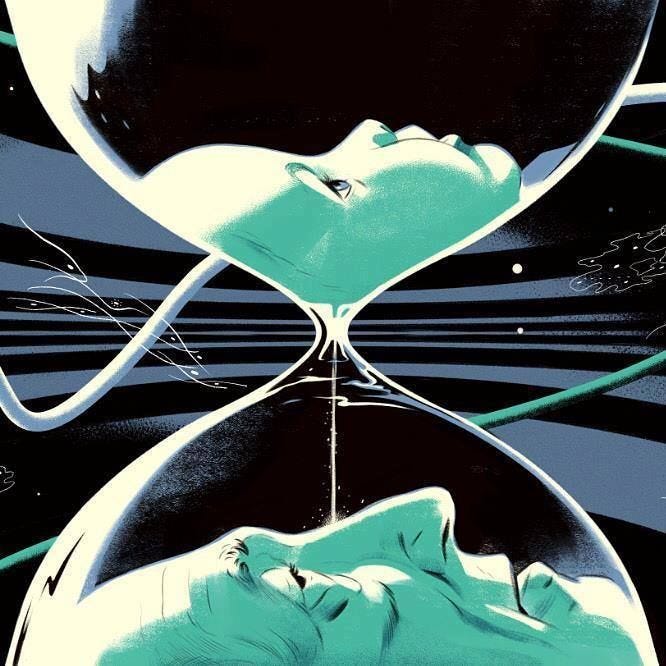
Resist the Urge to Know Everything. There Is No Time.
We must get comfortable with the things we will never know.

We don’t have the time to learn everything, so we must get comfortable with the things we will never know.
This understanding quite literally fell into my lap. It happened when I asked myself why I couldn’t put my phone down. I was trying to understand the source of my phone addiction. There was a time when it felt cute—harmless—and now it doesn’t feel so cute anymore. At first, I thought it was the fear of missing out, but that didn’t quite do it for me, because sometimes I don’t even want to be involved. I deeply enjoy my own time. So what could it be?
I realized it wasn’t the fear of the unknown—it was the fear of not knowing.
And why is that? Well, if you’re reading this, then you’re on Substack—or maybe you’re reading it somewhere else, which would actually be interesting to me. But if you’re here, I’ve noticed that a lot of us are readers. We like to read. We want to find things out—not just stories. Some of us read articles. Some of us have obsessions. Some of us are nerds, and others aren’t really nerds, but they still have things they thoroughly enjoy learning about. In our quest to know more and more about life, we look at our phones as channels that give us access to information.
But what I’ve come to understand is this: it’s not everything I need to know, or everything I’m supposed to know.
I think back to the Garden of Eden and the desire to know—Eve’s very human longing to understand something more. In the pursuit of knowledge, she and Adam lost something very precious: peace. Sometimes we want to know things even when we can’t do anything with the information. Sometimes it’s good to know because you can act on it. Other times, you just want certainty, because as people, we don’t like being uncertain. But sometimes we lose a great deal for the sake of knowledge—especially knowledge that’s too heavy, knowledge that wasn’t meant to fall into our laps.
That’s how I feel about my phone, particularly social media. I just want to know. I want to know what’s funny. I want to know what’s popping. I want to know what’s going on, and how I play a part in it. But it’s not everything I’m meant to know. And honestly, I wouldn’t be able to do anything with that information anyway.
I don’t need to know what’s happening right now. I don’t need to pick up my phone five times in an hour to check my email, check my notifications, or scroll—scrolling for what? Yes, there’s dopamine, but I get dopamine from a lot of other things. What I really want is to know.
And I think some of us want that too.
What I’m saying is: we don’t have to know. This realization has honestly helped me even with school. It’s helped me allocate my time toward what’s important. I have so many passions, so many interests—even when it comes to classes. That’s the beauty of grad school: I have electives now alongside required classes, so it feels like there’s so much to explore. But then I ask myself—I might want to, but is that what’s important for me right now? Is this worth my time in this season?
The more I realize that my time is precious—and that I don’t have to know everything, at least not right now—the more space I create. I get more time to sleep, to breathe, to put my energy into what matters in that season. Honor your seasons. Resist the urge to know everything. There is no time for that. You can only focus on what is important to you.
There’s a saying that goes, blessed are the things we can’t change, for those are the things that we can’t destroy. I’d say instead: blessed are the things we will never know, for those are the things that can’t destroy us. Not to say ignorance is bliss—but to say, if you don’t know, that’s okay too. What matters is seeking out the information that is important. We should be able to discern the importance of things, and in doing so, understand that we are limited—very limited—people.
I was working on a research paper recently, and one of my theoretical frameworks was the limited capacity model. It suggests that we, as people, have a limited ability to process information at any given time. We can’t process everything, so we certainly can’t know everything. I’ve come to understand that when I give myself—and my brain—the time to focus on what’s important, I create value for myself, of myself, as a person. Time slows down a bit. I get to feel my days as they’re meant to be felt.
We often say we have time, as if it’s a fact, but it’s really just hope. We don’t have time. We never did. If time truly belonged to us, we’d be able to shape it however we wanted. But we can’t. We make plans, and then time just happens. That doesn’t mean we should rush—it means we should enjoy it.
There is beauty in things that are ephemeral. Time is one of them. You are too. And honestly, knowledge is too. Knowledge doesn’t last forever—it lasts only as long as you do. Yes, people die and life continues, but you don’t know if life continues when you die, because you’re not here to know it. Everything is temporary. And that’s the beauty of it.
So get comfortable with the things you may never, ever know. Life itself is temporary, and the knowledge you acquire here will be too.